Successful scleral lens wear requires the ability to apply and remove lenses from the eye as well as proper care of the lenses. This guide will review the essentials for scleral lens care.
Cleaning, Disinfection, and Storage
After removing scleral lenses from the eye, they must be properly cleaned and disinfected with one of the following methods:
Peroxide system: 3% hydrogen peroxide is preservative free and has broad antimicrobial activity. Clear Care is the primary peroxide system available in the United States.
- Neutralization of the peroxide is required using a catalyst, typically included with the solution. Clear Care uses a platinum disk built into the case that neutralizes the peroxide in 6 hours.
- Although a rinse of the lenses is not required, rinsing of scleral lenses after removing from the case should only be performed with sterile saline or scleral filling solutions.
- If a 6-hour neutralization cannot be achieved, the scleral lens must be rinsed thoroughly prior to application.
- Larger diameter scleral lenses may not fit appropriately in the provided Clear Care case. Larger cases are available for purchase from independent distributors, but the platinum disk must be removed from the traditional case and added to the larger case. Two separate cases can be used, each with their own platinum disk and the lens baskets disassembled.
- Do not rinse lenses with peroxide or instill directly in your eye. Non-neutralized peroxide can be highly irritating to the eye and may require medical attention.
Multipurpose Solutions: Multipurpose solutions are approved for use with gas permeable lenses, including scleral lenses. These solutions are used to clean, disinfect, condition, and store scleral lenes. They utilize digital pressure (rubbing) and chemicals to clean and disinfect the lens. A thorough rinse using approved rinsing solutions is required prior to lens application. Available multipurpose solutions in the United States include Boston Simplus, Unique pH, and Tangible Clean.
- After removing the lenses from the eye, they should be cleaned with digital pressure using clean fingers and the palm of your hand. Clean both sides of the lens.
- Lenses can be stored in a standard contact lens case and submerged with the multipurpose solution.
- Prior to lens application, the lenses should be thoroughly rinsed with sterile saline or scleral filling solution. Do not rinse with tap or distilled water.
- Fresh solution should be used each day. Do not reuse solution or top off existing solution.

Scleral Application (Filling) Solutions
When applying scleral lenses, the bowl of the lens must be filled with a sterile, non-toxic, preservative free solution. This fluid reservoir takes up the space between the back surface of the lens and the cornea and maintains contact with the surface of the eye throughout wear. Using improper solutions may result in toxicity to the cornea, leading to redness, irritation, and reduced vision.
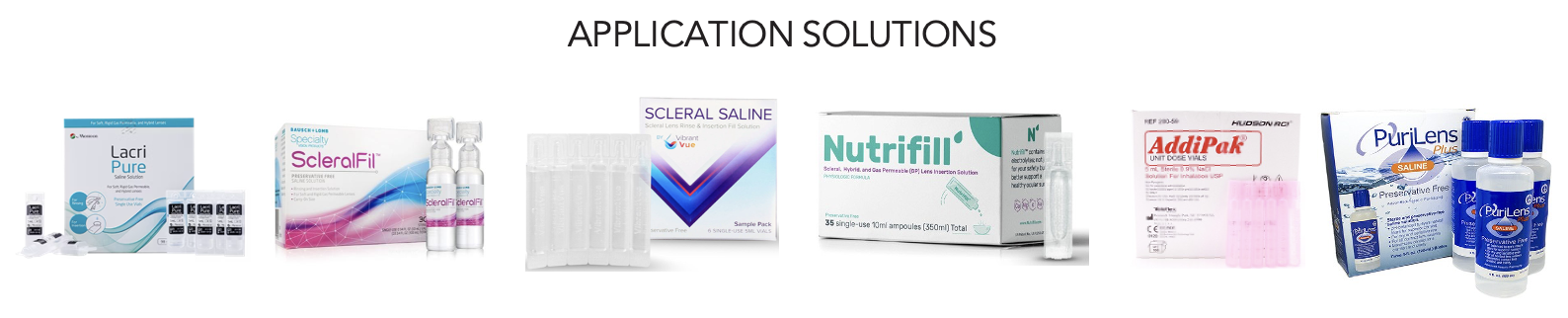
- Most approved application solutions come in single use vials. These vials should be discarded after rinsing and filling the scleral lenses once. Once the vial has been opened, there is risk of microbial contamination.
- FDA approved single vial solutions include LacriPure, ScleralFil, VibrantVue, and Nutrifill.
- 0.9% sodium chloride (Addipak), commonly used for nebulizers, is acceptable for off-label scleral lens use.
- PuriLens Plus is a sterile non-preserved saline available in 2 or 4 fluid ounce bottles. These bottles may be reused but should be discarded after 14 days or earlier if recommended by your scleral lens practitioner due to potential risk of contamination. Although acceptable, the use of bottled non-preserved saline is off-label for scleral lens use.
- Non-preserved artificial tears may be used to fill the scleral lens bowl if a thicker fluid reservoir is necessary.
Additional Care Products
Alcohol based cleaners: If scleral lenses deposit heavily with lipids (oil) or proteins, additional cleaners may be necessary to help clean the lens. Alcohol based cleaners are minimally abrasive and require digital pressure to remove the deposits.
- Alcohol based cleaners must be rinsed thoroughly before applying the lens to the eye.
- MiraFlow and Sereine cleaners are available for purchase online.
- Although acceptable for gas permeable contact lenses, their use is off-label for scleral lenses.
- These cleaners are NOT compatible with Tangible Hydra-PEG coated lenses.
Progent: This product by Menicon is a highly effective deposit and protein remover specifically for gas permeable lenses, including scleral lenses. Lenses are required to soak in the solution system for 30 minutes and require a thorough rinse before applying the lenses on eye.
- Progent is purchased online only or through some offices.
- Large diameter cases for scleral lenses are available for scleral lens use.
- Manufacturer recommendation is bi-weekly use; however, your scleral provider may recommend a different frequency of use.
- Progent is NOT compatible with Tangible Hydra-PEG coated lenses.
Tangible Boost: Tangible Hydra-PEG is a custom coating applied to the scleral lens to increase surface wettability, reduce deposits, reduce scleral lens fogging, and improve lens comfort. The initial coating is added during the manufacturing process and can wear off over time. Tangible Boost is a conditioning solution that restores and maintains the Hydra-PEG coating on lenses.
- The Tangible Boost system is prescription only.
- Suggested frequency of use is monthly or as directed by your scleral lens provider.
- Visit this link for a comprehensive guide on Tangible Boost
Scleral Application Tools
There are several different techniques for applying and removing scleral lenses. Many patients prefer using suction cups or a ring to aid in these processes. To clean and disinfect these tools, it is recommended they soak in 3% hydrogen peroxide for a period of 3 hours and then rinsed with sterile saline or scleral filling solution. These tools should be replaced every 3 months.
Download the Scleral Lens Care Guide
Spanish Version